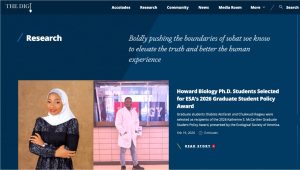
February 2026 : We congratulate two Ph.D. students from the NEGEC Lab, Olabisis Atofarati and Chukwudi Ikegwu, on their selection for the 2026 Katherine S. McCarter Graduate Student Policy Award (GSPA) by the Ecological Society of America. At the NEGEC Lab, we prepare students to make meaningful contributions through both scientific research and science-informed policy, strengthening the impact of conservation and biodiversity science
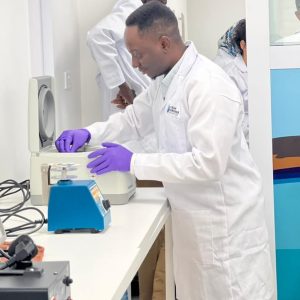
August 2025: A research article titled “Evaluating eDNA Metabarcoding for Fish Biodiversity Assessment in Nigerian Aquatic Ecosystems: Potential, Limitations, and Comparisons with Traditional Methods“, authored by Nneji (the lab’s PI) et al., was published in the Journal of Freshwater Ecology. As one of the first studies to employ environmental DNA (eDNA) metabarcoding for assessing fish biodiversity in Nigeria, this research offers foundational methodological insights to enhance future eDNA-based fish monitoring across Nigerian aquatic ecosystems
July 2025: Ms Olabisi Atofarati (PhD student) was awarded Rufford First grant for a project titled ‘Understanding the distribution and conservation patterns of poorly studied and threatened fish species in biodiverse Cross River Basin-Nigeria
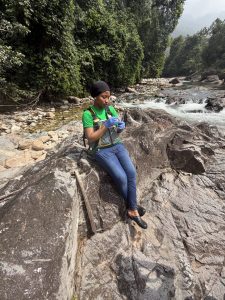
July 2025 Olabisi Afofarati
July 2025: A research article ‘Morphology, DNA Barcoding and Range Extension of a Poorly Known Freshwater Stingray Fontitrygon garouaensis Stauch & Blanc, 1962 from Nigerian Inland Water’ was published in Integrative and Comparative Biology by Oladipo et al., marking a significant advancement in the geographic understanding of the elusive Niger stingray.
June 2025: A research article ‘An Updated Ichthyofaunal Checklist for the Nigerian Lagos Lagoon with Notes on Nomenclatural Changes and the Conservation Status of Species’ was published in Zootaxa by Oladipo et al.
May–June 2025: Olabisi Atofarati conducted fieldwork in rural communities across Cross River and the Niger Delta. During this period, she performed environmental DNA (eDNA) sampling, facilitated community engagement sessions, and led conservation education and sensitization activities. These hands-on experiences deepened her understanding of the threats to fish biodiversity and reinforced her dedication to science-driven, community-inclusive conservation policies.
May–June 2025: Chukwudi conducted a comprehensive ecological field survey on amphibians and reptiles in the Obudu Plateau, Nigeria. His study focused on montane herpetofauna, during which he engaged local communities on the ecological importance of these species, trained them on basic sample collection techniques, and emphasized their role in supporting science and conservation. He collected tissue samples, performed morphological measurements, and prepared voucher specimens of recorded amphibians and reptiles.
May–July 2025: Kennedy K. Smith successfully completed a National Science Foundation Research Experience for Undergraduates (NSF-REU) internship at the DuVal Lab, Florida State University. During her fieldwork in the dry tropical forests of Isla Boca Brava, Chiriquí Province, Panama, she conducted behavioral experiments on arboreal Acacia ants (Pseudomyrmex spinicola), focusing on variation in ant aggression across regions of their host trees. She also assisted with fieldwork on Lance-tailed manakins. Back in Tallahassee, she contributed to data processing, statistical analysis, and genetic laboratory procedures, including DNA extraction and genotyping for paternity analysis in manakins. She concluded her internship by presenting her research at the annual Animal Behavior Society conference.
May 2025: Ms Erica Lowery (Fisk University) joins the lab for undergraduate summer internship programme.
May 2025: Olabisi Atofarati was selected for the P.T.O. Act Scholarship and received the Zymo Graduate Student Kit Support to advance her molecular research.
May 2025: Dr. Segun Olayinka Oladipo was awarded the PADI Foundation Grant in support of his project titled Safeguarding the Last Remaining Populations of Sharks in Nigerian Coastal Waters Through a Community-Based Approach and Education. This grant reinforces his commitment to marine conservation and local engagement.
May 2025: Dr Lotanna Nneji (Principal Investigator) was awarded the PADI Foundation Grant in support of the project title ‘Comparison of species-specific qPCR and metabarcoding methods to detect distribution patterns of highly threatened freshwater stingrays in Nigeria from environmental DNA’.
May 2025: Chukwudi Ikegwu was honored with the Jodie Sides Memorial Conservation Scholarship by the Washington Wild Sheep Foundation in support of his research on herpetofauna diversity in West Africa. This award highlights his commitment to using molecular approaches in conservation and biodiversity monitoring.
May 2025: Chukwudi Ikegwu received the Point’s Persistence Scholarship from Point Foundation, which recognized his resilience and dedication in both academic and personal pursuits.
April 2025: Olabisi received the PEO International Peace Scholarship in recognition of her commitment to fostering international understanding and collaboration through science.
January 2025: Chukwudi Ikegwu was awarded the James Patterson Writer Education Scholarship in recognition of his academic excellence and dedication to advancing teaching and writing skills, and he became a James Patterson Fellow.
January 2025: Dr Lotanna Nneji (Principal Investigator) was awarded a grant by Mohammed bin Zayed Species Conservation Fund for the project “Saving the last remaining populations of the critically endangered Niger stingray (genus Fontitrygon) in Nigeria through research and actions”.
January 2025: Dr. Lotanna Nneji (Principal Investigator), in collaboration with researchers from Nigerian universities, has published a paper titled “Human–Reptile Cohabitation and the Associated Conservation Dilemmas in Nigeria” in Biodiversity.
December 2024: Olabisi Atofarati was awarded the prestigious FONSECA Grant in support of her conservation efforts. This funding enabled her to explore indigenous knowledge systems and promote community-led conservation of the endemic and threatened Redline pufferfish (Tetraodon pustulatus) in the Niger Delta region.
August 2024: Olabisi Atofarati joined the NEGEC Lab to pursue her PhD, focusing on the molecular ecology and conservation of fish biodiversity in Nigeria. Her research integrates DNA barcoding, metabarcoding, and metagenomics to examine gut microbiomes, diet composition, and ecological roles of economically important Nigerian fish species.
August 2024: Chukwudi Ikegwu joined the NEGEC Lab to begin his PhD, focusing on the elevational distribution, diversity patterns, and conservation genomics of amphibians and reptiles in the West African montane regions. His research integrates field-based ecological studies with molecular data to address key questions in herpetofauna conservation. July 2024: Dr Segun Oladipo joins the NEGEC Lab as a Postdoctoral Research Fellow.
July 2024: A research article ‘DNA Barcoding and Morphological Characterization of Marine Stingrays (Genus Fontitrygon) from the African Gulf of Guinea’ was published in Aquatic Conservation: Marine and Freshwater Ecosystems by Oladipo et al.
February 2024: Dr Lotanna Nneji (Principal Investigator) was awarded Next Generation Leadership Award by the Advanced Genome Biology and Technology for early career leadership and innovation in genome biology.